
America's Test Kitchen LogoCook's Country LogoCook's Illustrated Logo

Reviews You Can Trust.
See Why.

Reviews You Can Trust.
See Why.

The Best Cocoa Powder

For the most chocolaty baked goods, which type of cocoa powder should you reach for?

Headshot of Sarah SandlerHeadshot of Kate Shannon Levine
By Sarah Sandler & Kate Shannon Levine

Published on September 29, 2026

What You Need to Know

If you’re baking chocolate cookies, cake, brownies or whipping up homemade hot chocolate or pudding, you’re going to need cocoa powder. It contains a higher proportion of flavorful cocoa solids than any other form of chocolate, so it can contribute bold flavor to a wide variety of treats. There’s fierce debate in the baking world about which type—Dutched, natural, high-fat—is best, and each style has staunch supporters who are convinced that using the wrong type will ruin a dessert. Does it really matter which you use? We tried Dutched and natural cocoa powders from top-selling brands like Hershey’s, Ghirardelli, and Guittard to see if they make or break a chocolate dessert.

Eight spoons filled with cocoa powder in different shades of brown.
Cocoa powder comes in a range of hues, from light, dusty tan to deep, amber-tinged brown.

How Is Cocoa Powder Made?

Cocoa powder starts with cacao pods, the fruit of the tropical evergreen tree Theobroma cacao. The bulk of the world’s cocoa is grown in West Africa, with South America, and Southeast Asia producing most of the remainder. Each pod contains between 20 and 50 beans (also called seeds). The beans generally taste bitter and are surrounded by a fruity-tasting, milky-white pulp, according to Gregory Ziegler, chocolate expert and professor emeritus of food science at Penn State University. The beans are fermented and then either roasted whole and then shelled to yield nibs, or they’re shelled and roasted as nibs (small pieces of crushed bean). Next, the nibs are ground into a paste called chocolate liquor, a mix of cocoa solids and cocoa butter. Chocolate liquor can be used as is in candy and chocolate, or it can be pressed to remove most of the fat (in the form of cocoa butter); the remaining solids are finely ground to make cocoa powder.

Dutched vs. Natural Cocoa Powder

In the 19th century, a Dutch chemist and chocolatier named Coenraad Van Houten developed an optional step known as Dutching (also called Dutch processing or alkalizing). Chocolate is naturally slightly acidic. Treating cocoa powder with an alkalizing agent (usually potassium carbonate or sodium carbonate) neutralizes the acid. Natural, untreated cocoa powder is usually sandy brown with a reddish tint and tastes bright and fruity. When we baked cake and cookies with natural cocoa powders, tasters picked up on “cherry” notes. Dutch processing darkens the color to velvety brown or near-black and mellows the cocoa’s more astringent notes, so deeper notes come to the forefront. Dutched cocoa is often the preferred option for professional bakers. Daisy Chow of Breadboard Bakery in Arlington, Massachusetts, chooses Dutched cocoa for the cakes and brownies she makes in the bakery. While she values it for its smooth chocolate flavor, she also loves the rich, dark color it contributes to baked goods. In our tastings, Dutched cocoa produced cakes and cookies that tasted “earthier” and more like “dark chocolate.”

Dutched and natural cocoa powders can have varying impacts on the final product, and you’ll see both styles used in our recipes. Because natural cocoa powder is acidic, it’s often used in recipes with baking soda, which requires acidic ingredients to produce a chemical reaction for leavening. In testing, cakes made with natural cocoa powder were a touch loftier and airier. Dutched cocoa powder is not acidic, so it’s often used in recipes that use baking powder as their leavening agent. Cookies and cakes with Dutched cocoa turned out a little bit more flat and fudgy. 

On the left, a cookie made with Dutched cocoa powder is a dark brown. On the right, a cookie made with natural cocoa powder is a reddish brown and slightly taller.
Leavening agents such as baking soda react with acid and moisture to create carbon dioxide, which causes baked goods to rise and creates a drier, airy texture (right). The Dutching process neutralizes some of the cocoa’s acidity, resulting in less lift and a fudgier consistency (left).

For best results, you should use the type of cocoa powder called for in the recipe. If the recipe doesn’t specify, either one will work. Both Dutched and natural cocoa powders were rated highly in our tastings, even when we tried them with recipes calling for the opposite style. Our tasters appreciated the bright and fruity notes of the natural powders, balanced by a touch of bitterness. They also enjoyed how the Dutched powders produced slightly more-moist baked goods with a deep, earthy flavor.

In Cocoa Powder, Fat Content Is Key

Fat content was a significant predictor in our rankings. When the cocoa liquor is pressed, some cocoa butter remains with the solids. Cocoa powders are generally classified as low-fat (around 10 percent fat) or high-fat (22–24 percent fat).

Nutrition facts on the back of a bag of cocoa powder with a red outline highlighting the fat content.
The less fat a cocoa powder has, the more absorbent fiber and starch it contains. We found that higher-fat cocoa powders yielded more moist and tender baked goods.

Baking with a low-fat cocoa powder means risking dry baked goods. Fiber and starch are present in all chocolate and cocoa powder. The less fat a cocoa powder has, the more of these absorbent carbohydrates it contains, explained our senior science research editor, Paul Adams. Combined, fiber and starch (when cooked) are able to soak up several times their own weight in moisture. This effect will be more significant in recipes with less butter or oil. Cocoa powders with lower fat levels ended up at the bottom of our rankings; baked goods made with them tended to be more “dry” and “crumbly.”

  • What to Look for: More than 0.5 grams fat per 5-gram serving
  • What to Avoid: 0.5 grams or less fat per 5-gram serving.

The Best Cocoa Powders

Our tasters liked the four top-performing cocoa powders almost equally. For natural cocoa powders, we loved Ghirardelli Premium Baking 100% Cocoa Powder and Guittard Organic Natural Cocoa Powder. Ghirardelli Premium Baking 100% Cocoa Dutch-Process and Guittard Cocoa Rouge Cocoa Powder were our favorite Dutched cocoa powders. One thing these powders had in common was that they were all high in fat—and therefore lower in fiber and starch—than some lower-performing products in our lineup. At the time of testing, the Ghirardelli cocoa powders were slightly less expensive, earning them our overall top spots.

FAQs

You may occasionally see “black cocoa powder” as an ingredient in store-bought baked goods or available to purchase on its own. It’s what gives Oreo cookies their dark color. It’s cocoa powder that has been ultra-Dutch-processed, increasing its alkalinity even further than traditional Dutched cocoa. It has an extremely dark color (hence the name) and an earthy flavor with less bitterness.

You may have noticed a jump in price for cocoa-derived products, from cocoa powder to chocolate bars and candy, or even the absence of chocolate altogether. Cacao is grown in tropical areas, with the vast majority grown in five countries—the Ivory Coast, Ghana, Ecuador, Nigeria, and Cameroon. In 2024, prices spiked due to a wide range of climate issues, namely extreme rainfall and drought, and resulting crop diseases. Wholesale prices have since come back down, but because cocoa production is so localized and highly dependent on ideal growing conditions, prices will likely continue to fluctuate due to the volatile weather conditions that result from climate change.

Everything We Tested

Recommended

Best Natural Cocoa PowderGhirardelli Premium Baking 100% Cocoa Powder

Chocolate cake made with this natural cocoa powder was “complex and layered”—“slightly bitter, rich” and “fruity,” with “nuanced cherry notes.” Thanks to its high fat content, cookies were chewy, soft, moist, and a little “fluffy.”

Type: Natural

Fat: 0.83 g

Fiber: 1.6 g

Chocolate cake made with this natural cocoa powder was “complex and layered”—“slightly bitter, rich” and “fruity,” with “nuanced cherry notes.” Thanks to its high fat content, cookies were chewy, soft, moist, and a little “fluffy.”

Type: Natural

Fat: 0.83 g

Fiber: 1.6 g

Best Dutched Cocoa PowderGhirardelli Premium Baking 100% Cocoa Dutch-Process

Chocolate cake made with this natural cocoa powder was “complex and layered”—”slightly bitter, rich” and “fruity,” with “nuanced cherry notes.” Thanks to its high fat content, cookies were chewy, soft, moist, and a little “fluffy.”

Type: Dutched

Fat: 0.83 g

Fiber: 1.6 g

Chocolate cake made with this natural cocoa powder was “complex and layered”—”slightly bitter, rich” and “fruity,” with “nuanced cherry notes.” Thanks to its high fat content, cookies were chewy, soft, moist, and a little “fluffy.”

Type: Dutched

Fat: 0.83 g

Fiber: 1.6 g

Guittard Organic Natural Cocoa Powder

Cake made with this Dutched cocoa was a deep, dark brown color and tasted “earthier” and just “a bit bitter.” It produced picture-perfect sugar cookies that were a little “fudgy” and had a “very mild chocolate flavor.”

Type: Dutched

Fat: 0.83 g

Fiber: 1.6 g

Cake made with this Dutched cocoa was a deep, dark brown color and tasted “earthier” and just “a bit bitter.” It produced picture-perfect sugar cookies that were a little “fudgy” and had a “very mild chocolate flavor.”

Type: Dutched

Fat: 0.83 g

Fiber: 1.6 g

Guittard Cocoa Rouge Cocoa Powder

This Dutched cocoa produced one of the darkest chocolate cakes in the lineup. It was “moist” and almost a little “sticky.” The deep chocolate flavor had a little extra “complexity.” When we used it to make cookies, they spread a little and were a bit flatter than others. They had a “dark chocolate” flavor reminiscent of “Oreo” cookies.

Type: Dutched

Fat: 1 g

Fiber: 1 g

This Dutched cocoa produced one of the darkest chocolate cakes in the lineup. It was “moist” and almost a little “sticky.” The deep chocolate flavor had a little extra “complexity.” When we used it to make cookies, they spread a little and were a bit flatter than others. They had a “dark chocolate” flavor reminiscent of “Oreo” cookies.

Type: Dutched

Fat: 1 g

Fiber: 1 g

Recommended with Reservations

Penzeys Dutch Process Cocoa Powder

Chocolate cake made with this Dutched cocoa powder was picture-perfect, but it tasted a bit “basic, ” with a fairly mild chocolate flavor that “didn’t scream chocolate.” The cookies we made had a rich color and the “slightest touch of bitterness.”

Type: Dutched

Fat: 1.43 g

Fiber: 1.43 g

Chocolate cake made with this Dutched cocoa powder was picture-perfect, but it tasted a bit “basic, ” with a fairly mild chocolate flavor that “didn’t scream chocolate.” The cookies we made had a rich color and the “slightest touch of bitterness.”

Type: Dutched

Fat: 1.43 g

Fiber: 1.43 g

Penzeys Natural Cocoa Powder

The chocolate cake we made with Penzey’s natural cocoa had a slightly amber hue and was a little on the dry side. Cookies had a lovely soft, chewy texture with notes of “warm spice” like cinnamon or nutmeg, but the cocoa flavor was “not particularly deep.”

Type: Natural

Fat: 1.43 g

Fiber: 1.43 g

The chocolate cake we made with Penzey’s natural cocoa had a slightly amber hue and was a little on the dry side. Cookies had a lovely soft, chewy texture with notes of “warm spice” like cinnamon or nutmeg, but the cocoa flavor was “not particularly deep.”

Type: Natural

Fat: 1.43 g

Fiber: 1.43 g

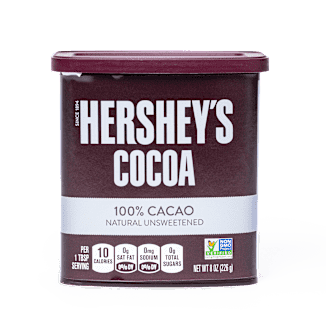
Hershey’s Cocoa

Tasters mostly enjoyed the “spongier,” “moist” texture of the chocolate cake made with this cocoa powder and found the flavor to be “pleasant” but “not intense.” Cookies were a bit “too crunchy” and “dry,” possibly due to the cocoa powder’s lower fat content. There was a “slight bitterness,” but overall, the chocolate flavor was “not very prominent.”

Type: Natural

Fat: 0.5 g

Fiber: 2 g

Tasters mostly enjoyed the “spongier,” “moist” texture of the chocolate cake made with this cocoa powder and found the flavor to be “pleasant” but “not intense.” Cookies were a bit “too crunchy” and “dry,” possibly due to the cocoa powder’s lower fat content. There was a “slight bitterness,” but overall, the chocolate flavor was “not very prominent.”

Type: Natural

Fat: 0.5 g

Fiber: 2 g

Nestlé Toll House Cocoa Powder

This lower-fat cocoa powder produced chocolate cake that was “dry” and “crumbly,” and the cake didn’t have a “particularly strong chocolate flavor.” The cookies were also a bit “crumbly” and the chocolate flavor was “dull and underwhelming.”

Type: Natural

Fat: 0.5 g

Fiber: 2 g

This lower-fat cocoa powder produced chocolate cake that was “dry” and “crumbly,” and the cake didn’t have a “particularly strong chocolate flavor.” The cookies were also a bit “crumbly” and the chocolate flavor was “dull and underwhelming.”

Type: Natural

Fat: 0.5 g

Fiber: 2 g

Reviews You Can Trust

The mission of America’s Test Kitchen Reviews is to find the best equipment and ingredients for the home cook through rigorous, hands-on testing. Have a question or suggestion? Send us an email at atkreviews@americastestkitchen.com. We appreciate your feedback!

Appears In

This item is featured in the following. Click the links to dig in!

*All products reviewed by America’s Test Kitchen are independently chosen, researched, and reviewed by our editors. We buy products for testing at retail locations and do not accept unsolicited samples for testing. We list suggested sources for recommended products as a convenience to our readers but do not endorse specific retailers. When you choose to purchase our editorial recommendations from the links we provide, we may earn an affiliate commission. Prices are subject to change.

This is a members' feature.
America's Test Kitchen LogoCook's Country LogoCook's Illustrated Logo