Raspberry Danish
By Andrea GearyPublished on October 16, 2026
Time
1¾ hours, plus 7½ hours freezing, chilling, and rising
Yield
Makes 12

Ingredients
Dough
163 grams (⅔ cup) milk2 large eggs, divided28 grams (2 tablespoons) unsalted European-style butter, melted331 grams (2⅓ cups) all-purpose flour37 grams (3 tablespoons) granulated sugar1 tablespoon instant yeast¾ teaspoon plus pinch table salt, dividedButter Block
257 grams (18 tablespoons) unsalted European-style butter, cut into 18 pieces, chilled18 grams (2 tablespoons) all-purpose flourFilling
188 grams (⅔ cup) raspberry jam1 tablespoon cornstarchGlaze
57 grams (½ cup) confectioners’ sugar20 grams (2 teaspoons) milkIcing
113 grams (1 cup) confectioners’ sugar20 grams (2 teaspoons) milkBefore You Begin
Danish takes at least 9 hours to make from start to finish, but the process can be spread over two days. Because it’s important to keep the dough cool, we don’t recommend making danish in a kitchen that’s warmer than 75 degrees. Using a higher-fat European-style butter such as Plugra, Lurpak, or Kerrygold makes the rolling and folding process easier.
Instructions
- Line rimmed baking sheet with parchment paper and spray lightly with vegetable oil spray. Whisk 163 grams (⅔ cup) milk, 1 large egg, and 28 grams (2 tablespoons) unsalted European-style butter, melted together in bowl of stand mixer. Add 331 grams (2⅓ cups) all-purpose flour, 37 grams (3 tablespoons) granulated sugar, 1 tablespoon instant yeast, and ¾ teaspoon table salt. Fit mixer with dough hook and mix on low speed until cohesive dough forms, 2 to 3 minutes. Increase speed to medium-low and knead until dough is well combined and elastic (it may still cling to sides of bowl), about 5 minutes. Transfer dough to prepared baking sheet (do not wash bowl) and, with your lightly greased hands, flatten to rough 10 by 8-inch rectangle. Cover and refrigerate for 2 hours. Whisk remaining 1 large egg and pinch salt in small bowl until smooth and refrigerate egg wash until needed.
- Add 257 grams (18 tablespoons) unsalted European-style butter, cut into 18 pieces, chilled and 18 grams (2 tablespoons) all-purpose flour to now-empty mixer bowl. Using paddle attachment, beat on medium-low speed until butter is malleable but still cool, about 2 minutes, scraping down bowl and paddle as needed. Meanwhile, fold 24-inch length of parchment in half to create 12-inch rectangle. Fold over 3 open sides of rectangle to form 8-inch square with enclosed sides. Crease folds firmly. Open parchment packet.
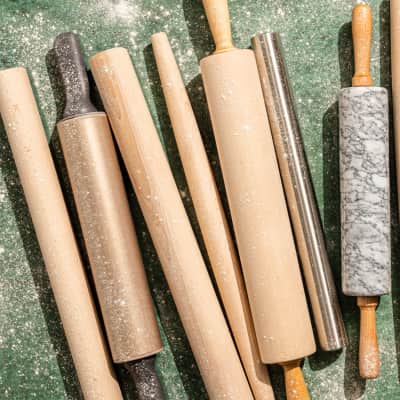
- Transfer butter mixture to prepared parchment square, fold parchment over mixture, and press to ½-inch thickness. Refold parchment at creases to enclose. Turn packet over so flaps are underneath and roll gently with rolling pin until butter mixture fills packet, taking care to achieve even thickness. Refrigerate until very firm, at least 45 minutes.
- Transfer dough to freezer for 30 minutes. After dough has been frozen for 30 minutes, remove butter packet from refrigerator to soften very slightly. Transfer dough to lightly floured counter and roll into 16 by 8-inch rectangle with long side parallel to edge of counter. Unwrap butter and place in center of dough. Fold sides of dough over butter so they meet in center. Press seam together with your fingertips. With rolling pin, press firmly on each open end of packet. Using long, smooth strokes, roll out lengthwise into 24 by 8-inch rectangle, dusting counter with flour as needed. Starting at bottom of dough, fold into thirds like business letter into 8-inch square. Turn dough 90 degrees clockwise. Roll out lengthwise again into 24 by 8-inch rectangle and fold into thirds. Wrap dough tightly with plastic, place on sheet, and return to freezer for 30 minutes.
- Transfer dough to lightly floured counter so that top flap opens on right. Roll out dough lengthwise into 24 by 8-inch rectangle and fold into thirds. Place dough on sheet, wrap tightly with plastic, and refrigerate for 2 hours or up to 24 hours.
- Unwrap dough and transfer to lightly floured counter. Press gently to expel gas. With sharp knife, cut dough in half, creating two 8 by 4-inch rectangles. Cover loosely and let sit at room temperature for 15 minutes. Roll each piece to 10 by 8-inch rectangle, then return to baking sheet, cover, and refrigerate for 30 minutes to let gluten relax.
- Line second rimmed baking sheet with parchment paper. On lightly floured counter, roll each dough piece to 12½ by 8½-inch rectangle (keep lifting dough from counter to ensure that it won’t retract once cut).
- Trim edges of rectangles with knife to 12 by 8 inches. Cut each rectangle into six 4-inch squares (3 across and 2 down). Transfer to prepared baking sheets, placing 6 squares on each sheet.
- Cover and let rise until doubled in height, 2 to 2½ hours. While pastries are rising, make filling, glaze, and icing.
- Stir 188 grams (⅔ cup) raspberry jam and 1 tablespoon cornstarch until fully combined.
- Stir 57 grams (½ cup) confectioners’ sugar and 20 grams (2 teaspoons) milk until smooth. If consistency is thicker than that of heavy cream, stir in water ¼ teaspoon at a time.
- Stir 113 grams (1 cup) confectioners’ sugar and 20 grams (2 teaspoons) milk until smooth. Icing should flow easily from spoon. If too thick, stir in water ¼ teaspoon at a time.
- About 20 minutes before baking, adjust oven racks to upper-middle and lower-middle positions and heat oven to 425 degrees. Brush tops of pastries lightly with egg wash. Using your fingertips, gently make 2-inch well in center of each danish and pierce each well three times with fork. Spoon 1 tablespoon filling into each well. Place both sheets in oven and reduce temperature to 375 degrees. Bake until deep golden brown, 20 to 22 minutes, switching and rotating pans after 12 minutes.
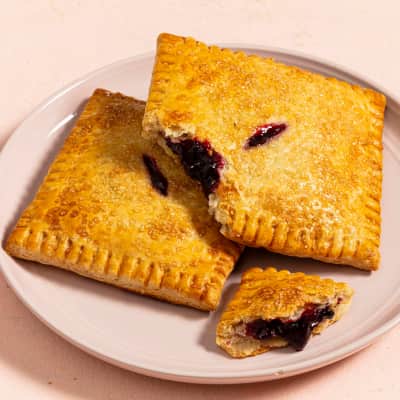
- Transfer pastries to wire rack. Brush hot pastries with glaze, avoiding filling. Let cool 10 minutes. Drizzle with icing. Serve warm or at room temperature. (Leftover danish can be stored at room temperature for up to 2 days.)
TO MAKE AHEAD: Follow recipe through step 8. Cover and freeze danish on sheets until solid. Transfer pastries to zipper-lock bag and freeze for up to 3 weeks. Before baking, let frozen pastries rise on parchment-lined sheets, covered, at cool room temperature overnight (no warmer than 70 degrees and no longer than 8 hours). Proceed from step 10.
for the dough
for the butter block
for the filling
for the glaze
for the icing


Time
1¾ hours, plus 7½ hours freezing, chilling, and risingYield
Makes 12Ingredients
Ingredients
Ingredients
Why This Recipe Works
The layered structure that is the hallmark of a classic danish pastry is created through a process called lamination: A yeasted dough is wrapped around a block of butter, and then the package is rolled out and folded three times to form 28 paper-thin layers of dough separated by 27 even thinner layers of butter. Using the right butter makes the rolling process easier. The higher water content of conventional butter causes it to break up in the dough, which can cause the layers to stick together, resulting in less lift. Using higher-fat (and thus lower-moisture) European-style butter works much better. Giving the dough and butter packet some intense 30-minute chills in the freezer brings the two components to a more comparable consistency, making it easier to maintain distinct layers.
When the pastries are baked, the moisture in the dough turns to steam, expands, and pushes the dough layers apart, forming that flaky, many-leaved structure characteristic of high-quality laminated pastries. In our raspberry danish, a small amount of cornstarch mixed into jarred jam absorbs extra moisture as the filling heats up in the oven, which prevents it from boiling over and marring the appearance of our danish.




0 Comments