America's Test Kitchen LogoCook's Country LogoCook's Illustrated Logo

Reviews You Can Trust.
See Why.

Reviews You Can Trust.
See Why.

The Best Gruyère Cheese

The right Gruyère is buttery and complex, is pleasantly firm and dense, and melts like a champ. If you aren’t buying it, you should be.

Headshot of Kate Shannon Levine
By Kate Shannon Levine

Published on May 1, 2017

Top Pick

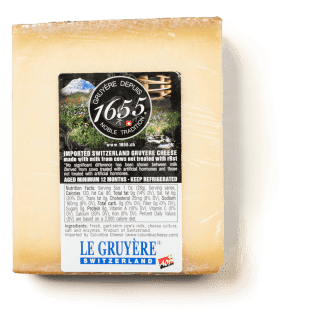
Winner1655 Le Gruyère AOP

Our winner had the highest fat content and one of the lowest moisture contents, and it was aged the longest: 12 to 14 months. Those factors added up to a cheese that tasters raved about—specifically its “excellent crystalline structure”; “dense,” “fudgy” texture; and “deeply aged, caramel-like,” “grassy” flavor that came through even when baked with spinach and onions.

AOP: Yes

Age: 12 to 14 months

Fat: 35.63%

Milk: Raw

Origin: Switzerland

Sodium: 583.1 mg

Moisture: 32.79%

Ingredients: Raw cow’s milk, salt, cultures, rennet

Price at Time of Testing: $19.99 per lb ($1.25 per oz)

Our winner had the highest fat content and one of the lowest moisture contents, and it was aged the longest: 12 to 14 months. Those factors added up to a cheese that tasters raved about—specifically its “excellent crystalline structure”; “dense,” “fudgy” texture; and “deeply aged, caramel-like,” “grassy” flavor that came through even when baked with spinach and onions.

AOP: Yes

Age: 12 to 14 months

Fat: 35.63%

Milk: Raw

Origin: Switzerland

Sodium: 583.1 mg

Moisture: 32.79%

Ingredients: Raw cow’s milk, salt, cultures, rennet

Price at Time of Testing: $19.99 per lb ($1.25 per oz)

What You Need to Know

What most Americans think of as “Swiss cheese” is the mild, holey stuff called Emmentaler. That cheese is fine for slicing thin and piling on ham sandwiches, but it bears little resemblance to its fellow citizen, Gruyère. The latter, which has been made in the eponymous alpine region of Switzerland for more than 900 years, is pleasantly firm and dense, slightly crumbly, and boasts that faint crystalline crunch that high-quality aged cheeses such as cheddar and Parmesan are known for. Good versions taste deeply nutty and have sweet, fruity tang; nice salinity; and a good bit of earthy funk. Gruyère is also one of a very few cheeses, Swiss or otherwise, that functions just as well in cooked applications as it does on a cheese plate. Scan the test kitchen’s recipe archive and you’ll find roughly 100 recipes featuring it—from breads, soufflés, frittatas, and gratins to scrambled eggs, mashed potatoes, fondue, and French onion soup.

As Gruyère’s stateside popularity has grown over the years, so, too, has its availability in American supermarkets. When we shopped recently, we found eight nationally available options, priced from $14.99 to $23.99 per pound. Five were Swiss imports bearing the Appellation d’Origine Protégée (AOP) seal, meaning they were made according to strict government-mandated rules and quality standards. The other three were domestic facsimiles; two of those, both made by Emmi Roth, stopped calling themselves “Gruyère” several years ago in deference to the Swiss-made cheeses. To find a favorite, we sampled each plain at room temperature, baked in spinach-and-cheese squares, and melted on crostini.

The Swiss Way

Swiss cheesemakers claim that every part of the rigorous AOP-regulated process contributes to Gruyère’s unique, deeply complex flavor and dense, crystalline texture, starting with the milk itself. It must be raw and from mostly grass-fed cows, since both the Alpine grasses and the bacteria naturally present in unpasteurized milk infuse the cheese with flavor. From there, the milk is mixed with cultures and rennet, which introduce more flavorful bacteria and cause the milk to coagulate into curds, respectively. Then it’s heated in giant copper vats. That particular vessel is important not just because copper heats evenly and responds quickly to changes in temperature but also because copper ions from the surface of the vat leach into the milk and curds and react with compounds in the milk to form desirable and distinct flavor compounds.

Once the curds have formed, they’re transferred to large wheel-shaped molds to be pressed for the better part of a day; turned out and either salted or brined for another day or two; and, finally, aged for a minimum of five months before being sold. The wheels are regularly turned and rubbed with salt during the aging process, which ensures that the rind forms properly and that the butterfat is evenly distributed. They’re also rubbed with a “smear” of cultures, which Dean Sommer, cheese and food technologist at the University of Wisconsin–Madison’s Center for Dairy Research, explains is the most important factor in creating the flavor of each maker’s Gruyère. “The surface ‘smear’ cultures are absolutely unique to each cheese plant,” he said, “which means that no two plants making a Gruyère-style cheese will have the exact same cheese flavor, even if the composition of the cheeses is nearly identical in the two plants.”

With Age Comes Flavor

We weren’t surprised to find that the Swiss-made cheeses, all of which we recommend, generally did taste noticeably “more intense,” “complex,” and “caramel-like” than the American-made ones. Two of the three domestic cheeses “lacked the characteristic notes” and “sparkle” of authentic Gruyère, and we can recommend them only with reservations. In fact, several tasters likened them to “bland” “deli Swiss” even in the cooked applications.

Those differences might be linked to the fact that domestic producers use pasteurized milk, which loses much of its flavorful bacteria in pasteurization’s intense heat, or that the Alpine grasses or specific cocktails of cultures used by Swiss cheesemakers yield better flavor. But the most likely reason the imported cheeses taste deeper and more complex than most domestic versions is that they’re aged longer. AOP standards dictate that Gruyère must be aged for at least five months. Our top four cheeses were aged for even longer—nine to 14 months. Among these was one of the domestic Gruyère-style cheeses, Emmi Roth Grand Cru Surchoix, whose relatively lengthy nine-month aging helped give it complex flavor despite the use of pasteurized milk. Of the other two domestic cheeses, one had no standards for aging and the other was aged for just four months.

Sommer confirmed that the longer a cheese is aged, the more intense and complex its flavor is going to be. That’s partly because enzymes from the starter cultures have more time to break down at a molecular level, creating more robust, unique flavor. Plus, as cheeses like Gruyère age, they lose moisture, which concentrates the protein, milk fat, flavor compounds, and sodium as well as calcium lactate and tyrosine—those crunchy crystals that our tasters loved. We confirmed via lab analysis that the older, top-rated cheeses contain less moisture and more fat than the younger, blander samples.

Sophisticated enough for a cheese plate and equally great for melting, Gruyère might be one of the most versatile supermarket cheeses for eating and cooking. It doesn’t come cheap—our favorite, 1655 Le Gruyère AOP, costs about $20 per pound—but we think it’s worth the splurge.

Everything We Tested

Recommended

Winner1655 Le Gruyère AOP

Our winner had the highest fat content and one of the lowest moisture contents, and it was aged the longest: 12 to 14 months. Those factors added up to a cheese that tasters raved about—specifically its “excellent crystalline structure”; “dense,” “fudgy” texture; and “deeply aged, caramel-like,” “grassy” flavor that came through even when baked with spinach and onions.

AOP: Yes

Age: 12 to 14 months

Fat: 35.63%

Milk: Raw

Origin: Switzerland

Sodium: 583.1 mg

Moisture: 32.79%

Ingredients: Raw cow’s milk, salt, cultures, rennet

Our winner had the highest fat content and one of the lowest moisture contents, and it was aged the longest: 12 to 14 months. Those factors added up to a cheese that tasters raved about—specifically its “excellent crystalline structure”; “dense,” “fudgy” texture; and “deeply aged, caramel-like,” “grassy” flavor that came through even when baked with spinach and onions.

AOP: Yes

Age: 12 to 14 months

Fat: 35.63%

Milk: Raw

Origin: Switzerland

Sodium: 583.1 mg

Moisture: 32.79%

Ingredients: Raw cow’s milk, salt, cultures, rennet

Mifroma Le Gruyère Cavern AOP

With low moisture, plenty of fat, and a judicious amount of salt, this long-aged Swiss import tasted “nutty” and complex—tasters picked up on fruity “pineapple” tang and a “savory onion quality.” Its “creamy” texture was strewn with pleasantly crystalline bites. In fact, one taster found “five visible tyrosine crystals in a single piece!”

AOP: Yes

Age: 9 to 11 months

Fat: 34.46%

Milk: Raw

Origin: Switzerland

Sodium: 585.5 mg

Moisture: 33.17%

Ingredients: Fresh part-skim cow’s milk, cheese cultures, salt and enzymes

With low moisture, plenty of fat, and a judicious amount of salt, this long-aged Swiss import tasted “nutty” and complex—tasters picked up on fruity “pineapple” tang and a “savory onion quality.” Its “creamy” texture was strewn with pleasantly crystalline bites. In fact, one taster found “five visible tyrosine crystals in a single piece!”

AOP: Yes

Age: 9 to 11 months

Fat: 34.46%

Milk: Raw

Origin: Switzerland

Sodium: 585.5 mg

Moisture: 33.17%

Ingredients: Fresh part-skim cow’s milk, cheese cultures, salt and enzymes

Emmi Roth Grand Cru Surchoix

Despite being made with pasteurized milk, this domestic cheese (made by a subsidiary of the Switzerland-based Emmi Group) boasted “caramelized” sweetness; notes of mushroom, onion, and “fruity red wine”; and a “buttery” texture that was loaded with crunchy tyrosine crystals.

AOP: No

Age: At least 9 months

Fat: 34.94%

Milk: Pasteurized

Origin: USA

Sodium: 534.6 mg

Moisture: 31.27%

Ingredients: Pasteurized cultured milk, salt, enzymes

Despite being made with pasteurized milk, this domestic cheese (made by a subsidiary of the Switzerland-based Emmi Group) boasted “caramelized” sweetness; notes of mushroom, onion, and “fruity red wine”; and a “buttery” texture that was loaded with crunchy tyrosine crystals.

AOP: No

Age: At least 9 months

Fat: 34.94%

Milk: Pasteurized

Origin: USA

Sodium: 534.6 mg

Moisture: 31.27%

Ingredients: Pasteurized cultured milk, salt, enzymes

Emmi Le Gruyère AOP Kaltbach

“Would be a showstopper on a cheese plate,” one taster remarked about this particularly “funky,” “fruity,” and “nutty” sample. Several others noted a pleasant fermented quality—like “sour apple juice”—or a “deep, lingering muskiness.”

AOP: Yes

Age: More than 12 months

Fat: 34.41%

Milk: Raw

Origin: Switzerland

Sodium: 526.6 mg

Moisture: 31.95%

Ingredients: Milk, culture, salt, enzymes

“Would be a showstopper on a cheese plate,” one taster remarked about this particularly “funky,” “fruity,” and “nutty” sample. Several others noted a pleasant fermented quality—like “sour apple juice”—or a “deep, lingering muskiness.”

AOP: Yes

Age: More than 12 months

Fat: 34.41%

Milk: Raw

Origin: Switzerland

Sodium: 526.6 mg

Moisture: 31.95%

Ingredients: Milk, culture, salt, enzymes

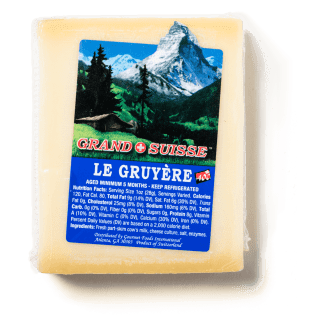
Grand Suisse Le Gruyère

Aged for just five months, this “waxy” Swiss Gruyère tasted noticeably leaner and “milder” than the older samples. It was “tangy but flat,” “semisharp,” and tasted “young.” That said, it still delivered “pleasant nuttiness” and “mellow tang.”

AOP: Yes

Age: 5 months

Fat: 32.76%

Milk: Raw

Origin: Switzerland

Sodium: 463.1 mg

Moisture: 34.46%

Ingredients: Fresh part-skim cow’s milk, cheese culture, salt, enzymes

Aged for just five months, this “waxy” Swiss Gruyère tasted noticeably leaner and “milder” than the older samples. It was “tangy but flat,” “semisharp,” and tasted “young.” That said, it still delivered “pleasant nuttiness” and “mellow tang.”

AOP: Yes

Age: 5 months

Fat: 32.76%

Milk: Raw

Origin: Switzerland

Sodium: 463.1 mg

Moisture: 34.46%

Ingredients: Fresh part-skim cow’s milk, cheese culture, salt, enzymes

Emmi Le Gruyère AOP

“Gruyère for beginners” is how one taster described this young, “buttery,” “nutty” import. Compared with the denser, more crystalline structure of our favorites, it was “smooth, soft, and creamy,” though texture wasn’t an issue in cooked applications.

AOP: Yes

Age: 5 to 6 months

Fat: 33.93%

Milk: Raw

Origin: Switzerland

Sodium: 659.2 mg

Moisture: 33.17%

Ingredients: Cultured milk, salt, enzymes

“Gruyère for beginners” is how one taster described this young, “buttery,” “nutty” import. Compared with the denser, more crystalline structure of our favorites, it was “smooth, soft, and creamy,” though texture wasn’t an issue in cooked applications.

AOP: Yes

Age: 5 to 6 months

Fat: 33.93%

Milk: Raw

Origin: Switzerland

Sodium: 659.2 mg

Moisture: 33.17%

Ingredients: Cultured milk, salt, enzymes

Recommended with Reservations

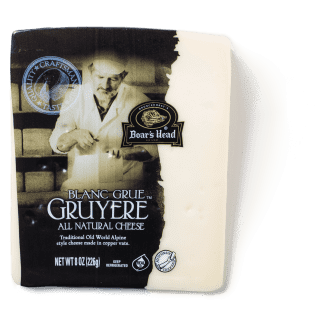
Boar’s Head Blanc Grue Gruyère Cheese

“Not offensive but no sparkle.” “Waxy” and “bendy.” “Innocuous.” These comments indicate that this domestic facsimile was aged for far less time than other cheeses. However, it melted evenly on crostini, and its flavor was “mild but pleasant,” with subtle nutty, sweet notes.

AOP: No

Age: No standard time frame

Fat: 32.90%

Milk: Pasteurized

Origin: USA

Sodium: 461.6 mg

Moisture: 34.38%

Ingredients: Pasteurized milk, cheese cultures, salt, enzymes

“Not offensive but no sparkle.” “Waxy” and “bendy.” “Innocuous.” These comments indicate that this domestic facsimile was aged for far less time than other cheeses. However, it melted evenly on crostini, and its flavor was “mild but pleasant,” with subtle nutty, sweet notes.

AOP: No

Age: No standard time frame

Fat: 32.90%

Milk: Pasteurized

Origin: USA

Sodium: 461.6 mg

Moisture: 34.38%

Ingredients: Pasteurized milk, cheese cultures, salt, enzymes

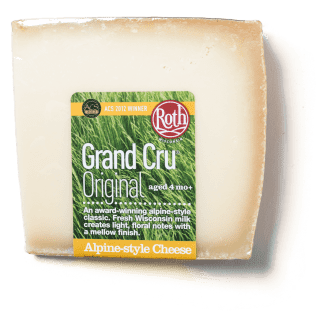
Emmi Roth Grand Cru Original

Several tasters compared this young cheese with deli Swiss—even calling it a “faker”—citing its “mild” (albeit “pleasant”) flavor and “rubbery” texture.

AOP: No

Age: 4 months

Fat: 31.69%

Milk: Pasteurized

Origin: USA

Sodium: 532.5 mg

Moisture: 34.76%

Ingredients: Pasteurized cultured milk, salt, enzymes

Several tasters compared this young cheese with deli Swiss—even calling it a “faker”—citing its “mild” (albeit “pleasant”) flavor and “rubbery” texture.

AOP: No

Age: 4 months

Fat: 31.69%

Milk: Pasteurized

Origin: USA

Sodium: 532.5 mg

Moisture: 34.76%

Ingredients: Pasteurized cultured milk, salt, enzymes

Reviews You Can Trust

The mission of America’s Test Kitchen Reviews is to find the best equipment and ingredients for the home cook through rigorous, hands-on testing. Have a question or suggestion? Send us an email at atkreviews@americastestkitchen.com. We appreciate your feedback!

The Expert

Headshot of Kate Shannon Levine

Kate Shannon Levine

Editorial Director, ATK Reviews

Kate is the editorial director for ATK Reviews. She's a culinary school graduate and former line cook and cheesemonger.

Kate Shannon Levine is the editorial director for ATK Reviews. She’s covered a wide variety of topics at America’s Test Kitchen, but she especially loves writing about cheese, pantry staples such as anchovies and kosher salt, and cleaning products. One of her proudest accomplishments is finding a life-changing kitchen sponge (really) and proving once and for all that it's a bad idea to leave a soggy sponge in the bottom of your sink. Prior to joining America’s Test Kitchen, she attended Boston University’s culinary program and worked as both a line cook and a cheesemonger.

Appears In

This item is featured in the following. Click the links to dig in!

*All products reviewed by America’s Test Kitchen are independently chosen, researched, and reviewed by our editors. We buy products for testing at retail locations and do not accept unsolicited samples for testing. We list suggested sources for recommended products as a convenience to our readers but do not endorse specific retailers. When you choose to purchase our editorial recommendations from the links we provide, we may earn an affiliate commission. Prices are subject to change.

This is a members' feature.
America's Test Kitchen LogoCook's Country LogoCook's Illustrated Logo