Updated Beef Wellington
By Steve DunnPublished on September 28, 2020
Time
3 hours, plus 13½ hours resting and salting
Yield
Serves 8 to 10
Featured Comment
"This was my first Wellington and it was incredible! I love the carryover cooking method! Impossible to mess it up!" —Izzy D.
Ingredients
Beef
1 center-cut beef tenderloin roast, 3 pounds trimmed weight, 12 to 13 inches long and 4 to 4½ inches in diameter1 tablespoon kosher salt1 tablespoon Dijon mustard1 teaspoon pepperPastry
503 grams (3¼ cups) bread flour314 grams (22 tablespoons/2¾ sticks) unsalted butter, cut into ½-inch cubes and chilled1 teaspoon table salt133 grams (½ cup plus 1 tablespoon) ice waterDuxelles
8 shallots, chopped4 garlic cloves, peeled2 pounds cremini mushrooms, trimmed and quartered, divided8 tablespoons unsalted butter¼ teaspoon pepper⅛ teaspoon table salt1 tablespoon Madeira2 teaspoons minced fresh thymeAssembly
12 slices prosciutto1 large egg plus 1 large yolkBefore You Begin
We recommend using a probe thermometer for this recipe. Center-cut beef tenderloin roasts are sometimes sold as Châteaubriand. Request a Châteaubriand from the thicker end of the tenderloin; some butchers refer to this as the “cannon cut.” Dry sherry can be substituted for the Madeira. Use packaged prosciutto rather than freshly sliced deli prosciutto, as the slices will be easier to handle. Although the timing for many of the components is flexible, we recommending making the Wellington over a three-day period: Prepare the components on the first day, assemble it on the second day (remember to reserve your leftover egg wash so that you can give the pastry a final coat before roasting it), and bake and serve it on the third day. You can serve with our Creamy Green Peppercorn Sauce and/or Madeira Sauce.
Instructions
- Sprinkle all sides of 1 center-cut beef tenderloin roast evenly with 1 tablespoon kosher salt. Wrap in plastic wrap and refrigerate for at least 12 hours or up to 3 days.
- Using stand mixer fitted with paddle, mix 503 grams (3¼ cups) bread flour, 314 grams (22 tablespoons/2¾ sticks) unsalted butter cut into ½-inch cubes and chilled, and 1 teaspoon table salt on medium-low speed until mixture is crumbly and pieces of butter are no larger than peas, 4 to 5 minutes. With mixer running, add 133 grams (½ cup plus 1 tablespoon) ice water in steady stream. Increase speed to medium and continue to mix until smooth dough comes together around paddle, 1 to 3 minutes longer. Transfer dough to lightly floured counter. Remove one-quarter (about 8 ounces) of dough and shape into 6-inch square. Shape remaining dough into 6-inch square. Wrap both pieces in plastic and refrigerate for at least 8 hours or up to 2 days.
- Process 8 chopped shallots and 4 peeled garlic cloves in food processor until very finely chopped, about 30 seconds, scraping down sides of bowl as needed. Transfer to small bowl. Pulse 1 pound cremini mushrooms, trimmed and quartered until mushrooms resemble couscous, about 10 pulses, scraping down sides of bowl halfway through processing (do not overprocess). Transfer to large bowl and repeat with remaining 1 pound cremini mushrooms, trimmed and quartered.
- Melt 8 tablespoons unsalted butter in 12-inch nonstick skillet over medium-low heat. Add shallot mixture and cook, stirring frequently, until softened, 3 to 5 minutes. Stir in mushrooms, ¼ teaspoon pepper, and ⅛ teaspoon table salt and cook, stirring occasionally, until liquid given off by mushrooms has evaporated and mushrooms begin to sizzle, about 45 minutes. Add 1 tablespoon Madeira to mushroom mixture and cook, stirring constantly, until evaporated, about 2 minutes. Off heat, stir in 2 teaspoons minced thyme. (If making duxelles ahead, let cool completely and refrigerate in airtight container for up to 3 days.)
- Overlap 2 to 3 pieces of plastic on counter to form 30 by 30-inch square (it's OK if up to 2 inches of plastic hangs off edge of counter). Shingle 12 slices prosciutto in center of plastic in 2 rows of 6 slices, slightly overlapping to form 14 by 15-inch rectangle, with shorter side parallel to edge of counter. Transfer duxelles to prosciutto and use offset spatula to spread in even layer, leaving 1-inch border of prosciutto on all sides (if duxelles is cold, microwave for 1 minute to soften before spreading).
- Unwrap beef and pat dry with paper towels. Brush all sides of beef with 1 tablespoon Dijon mustard and sprinkle with 1 teaspoon pepper. Arrange roast parallel to edge of counter, about one-third of way up duxelles. Using both hands, lift bottom edge of plastic to begin wrapping roast. Continue to roll roast, leaving plastic behind, until roast is completely wrapped in prosciutto. Tuck overhanging slices of prosciutto over each end of roast.
- Tightly roll roast in plastic and twist plastic tightly at each end to seal. Continue to twist ends of plastic and roll roast on counter until formed into snug cylinder. Refrigerate for at least 30 minutes or up to 2 days before cooking.
- Line 2 rimmed baking sheets with parchment paper. Roll out larger piece of dough on generously floured counter into 18 by 16-inch rectangle. Drape dough over rolling pin, transfer to prepared sheet, and refrigerate for 15 minutes. Roll smaller piece of dough into 16 by 7-inch rectangle. Transfer to second prepared sheet and refrigerate.
- Whisk together 1 large egg plus 1 large yolk. Lay large pastry sheet directly on counter with long side parallel to edge of counter. Brush entire surface with egg wash; set aside remaining egg wash. Unwrap beef and place on pastry, arranging it parallel to edge of counter and 2 inches from pastry edge closest to you. Wrap edge of pastry closest to you over beef. Holding edge in place, slowly roll roast away from you, keeping pastry snug to meat, until roast is covered.
- Allow pastry to overlap by 1 inch and trim away excess. Roll roast so seam is on top. Gently press and pinch overlapping dough to seal. Roll roast so seam is on bottom.
- To seal ends of roast, tuck sides of pastry tightly against meat as though you are wrapping a present, then fold top of pastry down, pressing snugly.
- Using rolling pin, roll excess dough at end of roast against counter to make it thinner and longer. Trim rolled end to 2-inch length and tuck under roast. Repeat process on other end of roast. Transfer roast seam side down to lightly greased rimmed baking sheet and refrigerate for at least 15 minutes or up to overnight (if refrigerating longer than 1 hour, wrap in plastic).
- Transfer smaller rectangle of dough, still on parchment, to counter, with short side parallel to edge of counter. Using ruler and sharp knife or pizza cutter, cut dough lengthwise into ¼-inch-wide strips.
- Brush top, sides, and ends of roast with some of reserved egg wash; set aside remaining egg wash. Lay strips of dough diagonally across top of roast, leaving ¼ to ½ inch between strips. Gently press strips to adhere to roast and trim excess at each end to ¼ inch. Using bench scraper, tuck ends of strips under roast. Refrigerate roast for at least 10 minutes. (Roast can be loosely covered with plastic and refrigerated for up to 24 hours.)
- Adjust oven rack to lower-middle position and heat oven to 450 degrees. Brush roast thoroughly with reserved egg wash. Place thermometer probe, if using, through 1 end of roast so tip of probe is positioned at center of roast. Roast until beef registers 85 degrees and crust is well browned and crisp, 40 to 45 minutes. Transfer sheet to wire rack, leaving probe in place to monitor temperature. Let rest, uncovered, until internal temperature reaches 130 degrees, 40 to 45 minutes.
- Slide large metal spatula under roast to loosen from sheet. Use both hands to transfer roast to carving board. Using serrated knife, cut roast into 1-inch-thick slices (to keep pastry intact, score through decorative strips before cutting each slice) and serve.
day one prep components—for the beef
for the pastry
for the duxelles
day two assemble
day three bake and serve

Time
3 hours, plus 13½ hours resting and saltingYield
Serves 8 to 10Featured Comment
"This was my first Wellington and it was incredible! I love the carryover cooking method! Impossible to mess it up!" —Izzy D.Ingredients
Test Kitchen Techniques
Ingredients
Test Kitchen Techniques
Ingredients
Test Kitchen Techniques
Why This Recipe Works
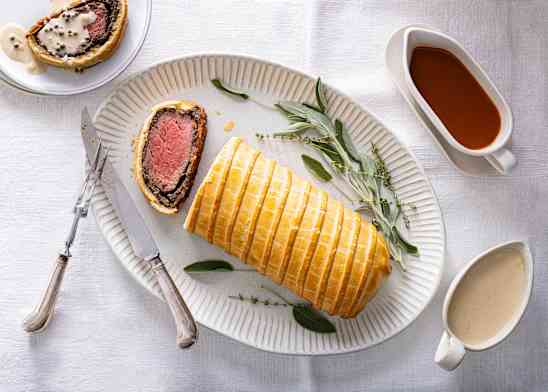
For beef Wellington packed with flavor, we salt beef tenderloin overnight, then slather it with piquant Dijon mustard before wrapping it in umami-rich prosciutto spread with superconcentrated duxelles. We trade the traditional puff pastry for sturdier, easier-to-work-with pâte brisée, which produces a firm yet flaky and tender crust that slices neatly when serving. Finally, we tackle the biggest challenge of making a Wellington: producing both a perfectly baked crust and uniformly medium-rare beef. To accomplish this, we roast the Wellington in a 450-degree oven and remove it when the beef registers a mere 85 degrees. Carryover cooking does the rest of the work, as the meat's temperature gradually rises to 130 degrees (medium-rare). We created a Creamy Green Peppercorn Sauce and a Madeira Sauce, giving us two delicious options for finishing the decadent dish.
Want more? Read the whole story





1021 Comments