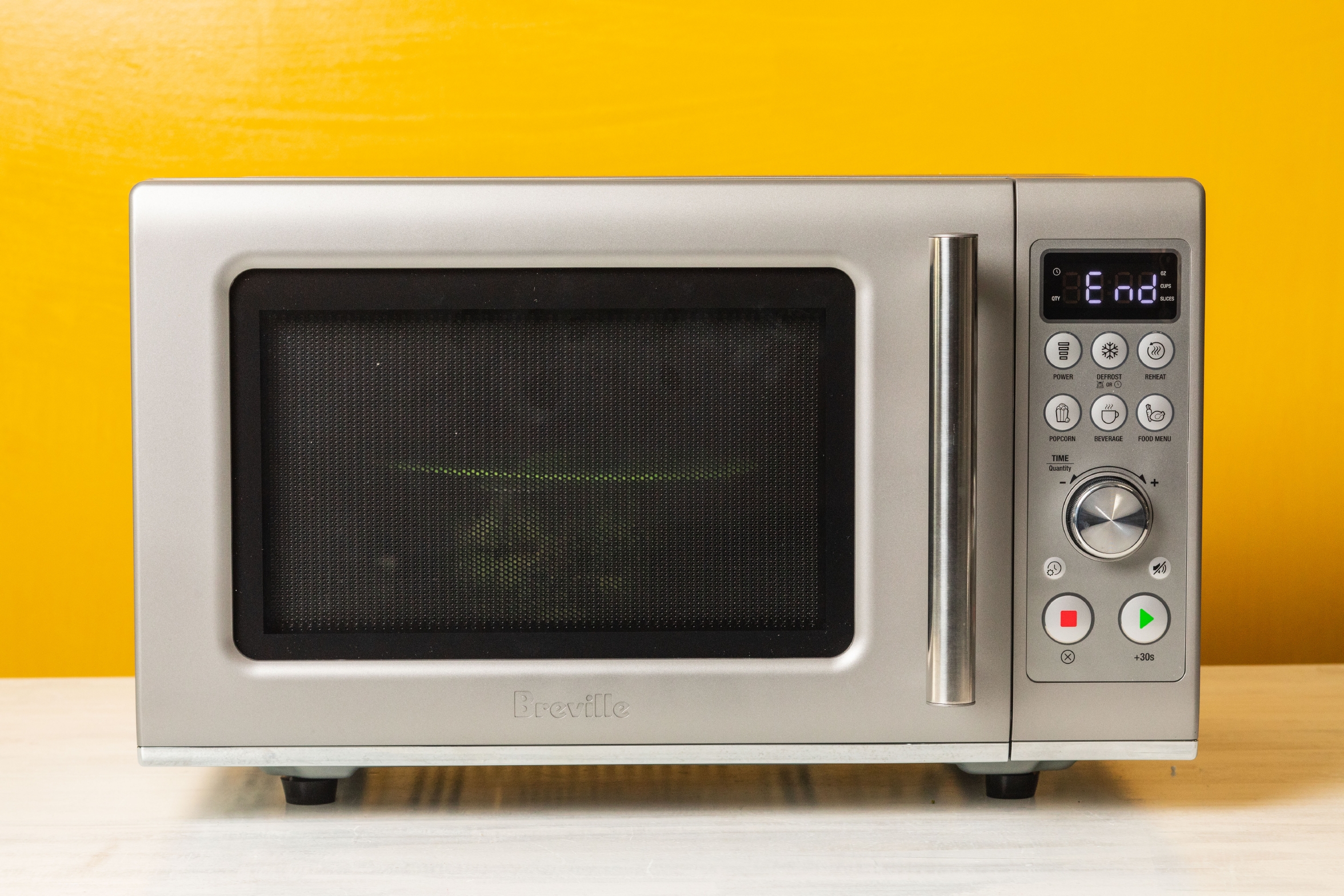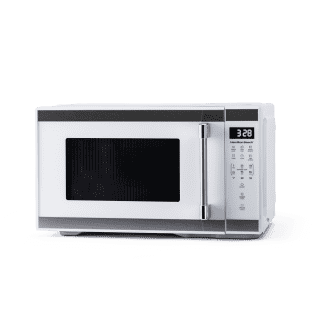



The best microwave ovens are easy to use and work reliably. Our favorite, Breville The Compact Wave Soft Close Microwave, won top marks for its excellent cooking results, supersimple controls, user-friendly design details, and brushed finish that didn’t show fingerprints. Our Best Buy is the Toshiba 0.9 cu. ft. Black Stainless Steel Microwave; it lacks the bells and whistles of our winner but delivered consistent, quick results.

Microwave ovens have a solid place in our kitchens today. Sure, they’re great for reheating leftovers, but increasingly we’ve been calling for them in recipes to take over jobs that they can do easier and faster than traditional methods, including frying shallots; blooming spices; removing excess moisture from raw mushrooms or eggplant; parcooking potatoes or squash before grilling; cooking polenta; helping shuck and/or steam corn on the cob; drying herbs; toasting nuts, bread crumbs, coconut, and seeds; and melting butter and chocolate. We’ve changed the way we think about these ovens, continuing to explore their potential usefulness well beyond “zapping” a tepid mug of coffee.


In the test kitchen, we use microwaves in a variety of ways, such as (from left) drying herbs, toasting nuts, and making mug cakes.
While microwave ovens can be installed, freestanding countertop microwaves remain the top sellers. Prices can range upward of $2,000, but we focused on models costing about $500 or less. We put them through a series of core tests and assessed extra features to see if they were worth seeking out. Our goal was to find the best performers that would also be easy to use and maintain.
How Microwaves Work
Microwave ovens are powered by a vacuum tube called a magnetron that uses electric current and magnets to generate electromagnetic waves called microwaves. These waves can pass right through glass, paper, plastic, and similar materials—but they’re absorbed by food. They make the food’s water molecules (and to a lesser extent, the fat molecules) vibrate, which produces heat that cooks the food.
Microwaves don’t penetrate very deeply; they reach only the outer layer of the item you are cooking. The rest of the food warms by conduction as the heat spreads inward from the hot surface. A turntable rotates to help even out the heating by moving food around in the waves. Even so, food often heats unevenly due to the presence of hot spots and cold spots throughout the oven.


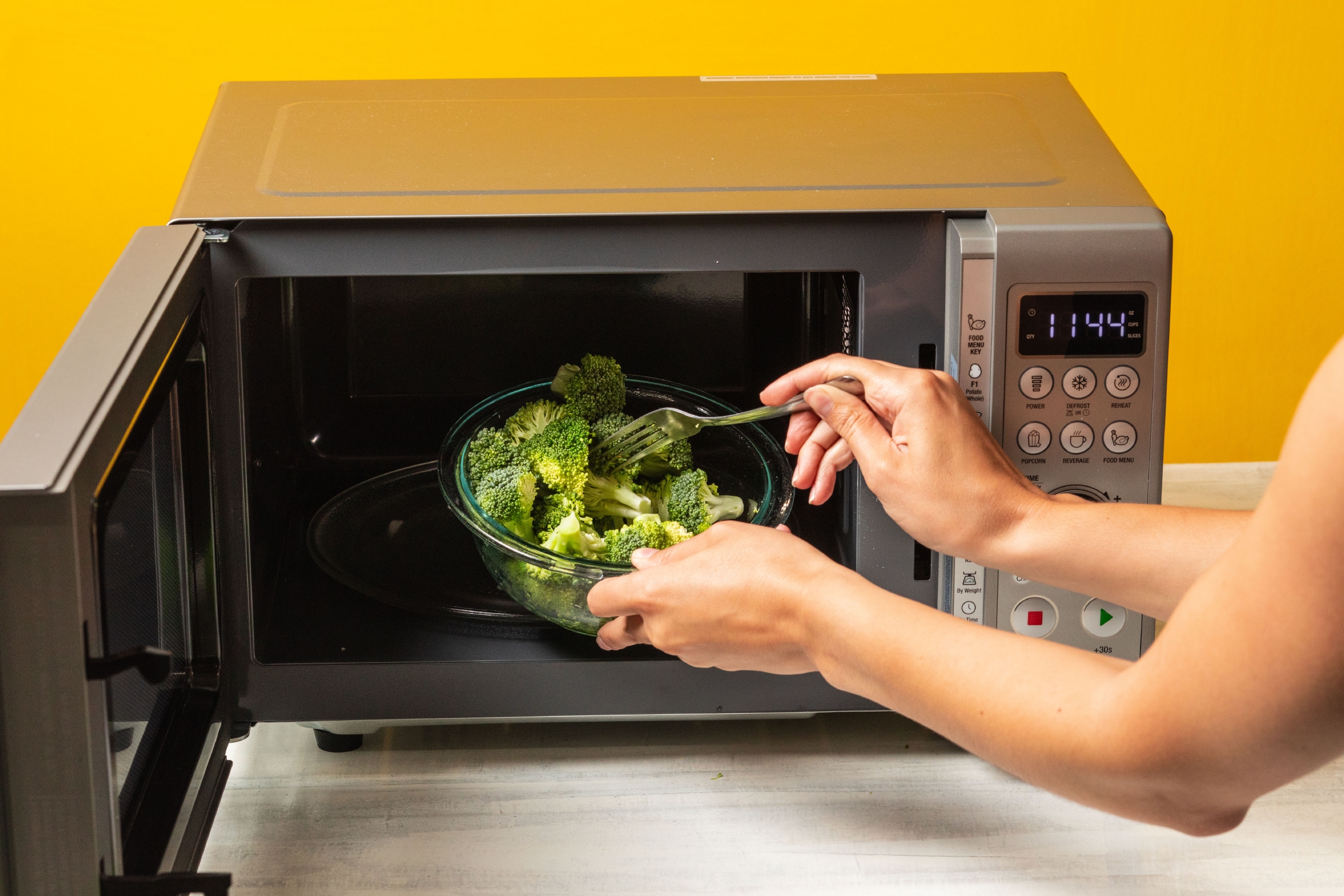
Microwaves heat food from the outside in. When defrosting soup or other frozen foods, stirring helps it warm evenly.
Recently, however, companies have added a variety of newer features to help improve performance and user-friendliness. These options include inverter technology, for more precise cooking at lower power levels, and sensor modes where the microwave measures steam emitted from foods and adjusts cooking power and time accordingly. You can find voice control using Google Assistant or Alexa as well as Wi-Fi connections to apps that operate the microwave or even scan food barcodes to send cooking instructions. A function called multi-stage cooking lets you set up stages of cooking to happen sequentially: for example, 10 minutes of defrosting followed by 3 minutes of heating. As we tested our microwave oven lineup, we learned which of these features mattered—and how to choose the best model.
Your Microwave’s Best-Kept Secret: Adjusting the Power Level
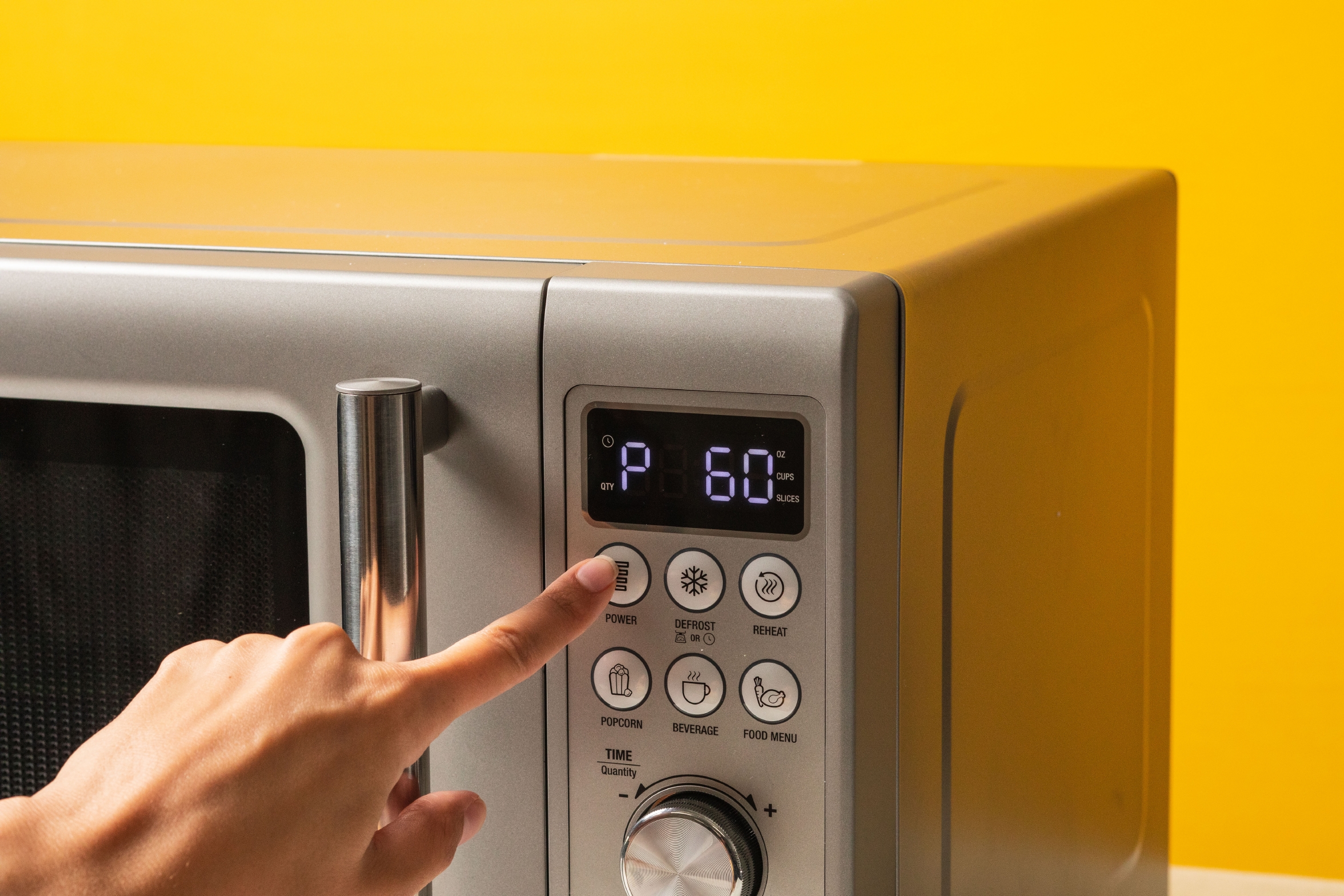
When you simply hit “start” on a microwave, it runs at full power. Microwaves can be set to run at lower, gentler power levels, but most people either don’t know about this feature or don’t know when to take advantage of it. Lower power settings are great for a number of things, including softening butter or tempering ice cream—or melting butter without exploding it. You can also reheat food more gently and evenly using lower power settings.


When softening butter in the microwave at full power, it’s common for sections to melt completely while the interior is still firm. Lowering the power level helps ensure that it softens evenly from end to end.
Traditional versus Inverter Microwaves
When running at full power—the way most people use them most of the time—traditional microwave ovens are virtually indistinguishable from inverter models. But when using a microwave at lower power settings, they’re quite different.
Traditional microwaves regulate power using a method called “pulse width modulation” (PWM). When you set a PWM microwave to cook at 50 percent power, it achieves this by cycling its magnetron, which generates the microwaves, on and off: It runs at 100 percent power for 15 to 30 seconds, then switches power off for 15 to 30 seconds, repeating that pattern for the entire cook cycle. You’ll hear a fan whirring, while a slightly louder hum switches on and off; that’s the magnetron kicking in. (Heat continues to conduct from the surface of the food toward the interior even when the magnetron cycles off.)
Inverter technology offers a different approach. These models use a specialized circuit that can change the intensity of the microwaves being produced. So instead of alternating between full blasts of power and no power at all, an inverter microwave delivers a steady, uninterrupted stream of energy at the specific lower
percentage you select. If you set an inverter model to 50 percent power, it emits a constant 50 percent output for the entire cook time.

With this in mind, remember that on a traditional microwave, it doesn’t make sense to microwave at lower power settings for anything less than about a minute because the microwave will still operate at full power for at least the first 15 to 30 seconds. And if you open the door to stir or check progress of your food, it will restart this on/off cycle, meaning that your microwave will still spend the majority of the cooking cycle at 100 percent power.
What to Look for
- Simple, Intuitive Controls: Microwaves should not require you to constantly consult manuals or complete advanced training to operate them. We prioritized machines that were easy to use right out of the box. Look for clearly marked, easy-to-decipher controls. Less is more: Who needs buttons for “Kids’ Meals” or “Healthy Cooking” or “Snack”? We also liked models that prompted us with the next steps as we used them.
- Moderate Size: Unless you routinely microwave and/or defrost very large amounts of food, we found that an oven with about 0.9 to 1.0 cubic feet of interior space was perfectly adequate. Bigger models hogged counter space and didn’t offer much additional usable interior room than our top models. Turntables ranged from 9⅝ inches to 14⅜ inches in diameter, but even the smallest easily fit a standard dinner plate. The smallest oven we tested, with 0.7 interior cubic feet, could be adequate for small households.
- Light, Bright Interiors: Our favorite ovens had lighter interiors and/or lit up brightly when we opened the door.


A brightly lit interior (left) helps the cook judge the food’s doneness, while a dim interior (right) makes that harder to do.
Nice to Have
- Sensor Cooking: Sensors monitor the steam emitted from food as it heats and adjust cooking time and power levels as needed. We found that cooking in models with sensor mode was more hands-off and saved us a few steps. It was helpful but not essential.
- Fingerprint-Free Finish: We examined the microwaves inside and out when testing was done. Several appeared grubby and fingerprint-smeared. The worst offenders had shiny, glassy black finishes and stainless-steel trim that showed every touch. The best had matte or white finishes that looked fresh even after heavy use—a handy plus if your microwave is on the counter in plain sight.


A brushed stainless finish (left) hides fingerprints and smudges, while a glossy black finish (right) shows every touch.
- Door Handles: Call us old-fashioned, but we enjoyed the ease of large vertical door handles versus the usual flat-panel buttons that demand a hard poke to open the door.
- “END” Display: Ovens that displayed an “END” signal when done saved us from icky discoveries like yesterday’s reheated coffee mug or a dish that never made it to last night’s dinner.

What to Avoid
- Confusing Controls: Pushing buttons and getting nowhere was frustrating. Some models loudly beeped or froze if we failed to follow a specific sequence to set cooking tasks. Our preferred models were easy to interpret; a few even guided us to the next steps.
- Scan-to-Cook Technology: You scan the barcode of frozen foods with an app that sends cooking instructions directly to the oven. This didn’t save much time, and three out of the five common supermarket entrées we tried were not in the app’s database.
- Voice Control: Unless you need this feature to make the oven more accessible, using Alexa or Google Assistant was underwhelming. Plus, you still need to use your hands to insert, remove, stir, and flip food.
Other Considerations
- Wattage: Our lineup’s output power levels ranged from 700 to 1,250 watts. You might assume the higher the wattage the better, but this was not necessarily true. With some basic best practices, you can coax out good results with most power levels. When operating a low-wattage microwave, such as the 700-watt model we tested, you may need to add time to fully reheat or cook your foods. If you choose a model with moderate wattage of about 900 to 1,000 watts, you can simply use full power for the suggested amount of time. With higher-power models, we recommend using a lower power setting and/or operating the microwave for less time than your recipe or package instructions state.
The Tests
- Melt butter at full power, partial power, and using “melt” setting
- Soften butter at partial power and using “soften” setting
- Melt chocolate
- Toast coconut
- Defrost frozen ground beef using partial power and using “defrost” setting
- Reheat mac and cheese (Stouffer’s brand, large size), using sensor mode where applicable
- Cook bacon, using sensor mode where applicable
- Recruit additional testers to evaluate ease of use
How We Rated
- Performance: We rated each model on its ability to perform common microwave-oven tasks with desired results and assessed any extra features we found helpful.
- Ease of Use: We evaluated how comfortable it was to operate the oven and whether controls were clear and intuitive.
- Cleanup: We rated whether it was easy to keep the oven interior, exterior, and control panel clean and in good condition.