


A portable induction burner is useful whether you live in a small space or need extra cooking capacity on big occasions. Our favorite is Breville’s the Control Freak Home, an updated, more compact version of Breville’s the Control Freak, which was designed for professionals. Easy and intuitive to use, our winner has a single knob and a touch screen that neatly displays the cooking settings and timer side by side. Its 8.5-inch induction coil—larger than most models on the market—helps it heat and brown faster and more uniformly. It comes with a probe for monitoring food or cooking to specific temperatures. Our Best Buy, the Duxtop Portable Induction Cooktop 9600LS, is at a fraction of the price and has few features and a smaller 6.5-inch coil, so browning was a bit more uneven; however we liked its intuitive control panel and wide temperature range.
See our guide to induction cooking, which has become increasingly popular. You’ll learn about how induction works and what the advantages and disadvantages are.
Not sure if induction is right for you? We’ve also tested portable gas and electric burners.

Induction burners contain a copper coil that produces a magnetic field when turned on. When a pan with a ferromagnetic bottom is placed on the burner, the energy from the magnetic field causes the material of the pan to produce heat. The coil won’t work unless you use a compatible pan (see “How Can You Tell If Your Cookware Is Induction-Compatible?”).
Since only the metal of the pan heats up, all the energy goes directly into the cookware, whereas with electric or gas stovetops, some of that energy spills over, heating the air and the surrounding stove area. This is one reason why induction burners are described as being more energy efficient, and why they can keep your kitchen cooler.
Induction stoves are often praised for their speed. While full-size induction ranges generally do heat much faster than electric or gas, standalone portable burners do not. This is because they are plug-in countertop appliances, which means that their power is limited to that of a wall outlet, whereas a full-size induction stove is far more powerful and requires a dedicated high-voltage plug. In our testing, portable models boiled water within a minute or two of one another and in about the same time it took on a gas stovetop.
How Cooking Is Different on Induction Burners, and What to Do
Induction burners stand out for their ability to change temperature much faster than gas or electric burners when you dial the heat up or down. In our testing, when we adjusted temperature settings, the heat level changed almost instantly, giving us excellent control. (While gas burners change temperatures faster than electric ones, the heavy metal grates that support cookware over gas burners retain heat, so pans still cool more gradually than on induction.) While we usually appreciated this speed, induction’s responsiveness sometimes contributed to difficulties with recipes developed for gas and electric ranges that require precision cooking.

As we made caramel sauce and cheese fondue, we realized that these recipes apparently depend on some carryover cooking even after the stove is dialed down. In our first attempts while testing induction burners, as soon as we lowered the heat, cooking progress came to a standstill—the melted sugar stopped browning, and the cheese stopped melting. We learned to leave the heat on the higher setting as we cooked, and most importantly, use both visual cues and a thermometer to monitor the recipes’ progress.
It’s also important to note that while the high-tech controls on induction burners may give you the impression that you can simply set the cooktop to 375 degrees and get perfectly heated 375-degree frying oil, for example, you would be mistaken. Induction burners will heat the pan itself to the temperature you set, then throttle to keep it at that temperature. As a result, the food in the pan is likely to remain cooler and not reach your target temperature. You can turn up the heat past your target to help get the contents hotter, but it’s an imprecise process, and one model we tested was still unable to reach our desired temperatures.
That’s where probes are designed to help, by letting you set the desired temperature of the food itself. This worked very well in our two highly recommended models, but frustratingly, another burner’s probe only worked in smaller pans at lower temperatures. When we tried to use it to heat deep-fry oil in a large Dutch oven to 375 degrees, the oil temperature stalled indefinitely at a lower temperature, in this case 331 degrees. Why? Overheat sensors inside induction burners monitor their surface temperature and shut down or lower the power output as necessary to protect the appliance. We suspect that the large cast-iron Dutch oven covering this burner’s surface triggered the sensors. By contrast, our top-rated burners avoided overheating. They are much bigger and taller than average induction burners because their cooling systems are larger and more effective, so they can handle high heat; this also makes them more expensive.
In the absence of a reliable probe, we learned to set the cooking temperature on maximum heat for that burner, and monitor progress with a thermometer. So when we wanted deep-fry oil to reach 375 degrees, we set the burner on its highest setting and used a thermometer to watch the oil temperature climb to our target. Our science editor explained that when you set the burner to its highest temperature, this raises the threshold for the overheat sensor.
How Can You Tell If Your Cookware is Induction-Compatible?

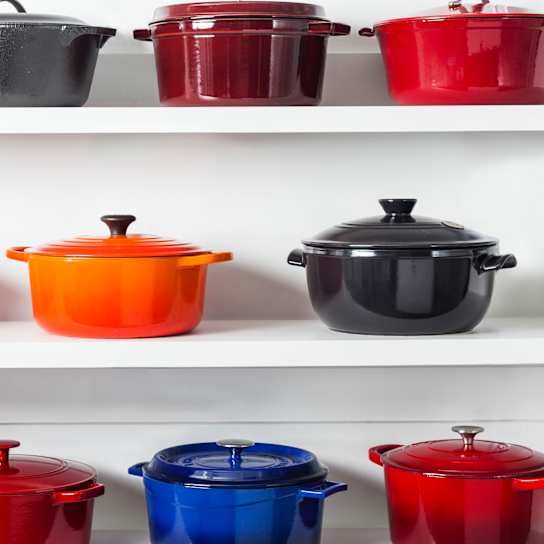
To cook with induction, you need compatible cookware. So, how can you tell if your cookware is compatible? If it’s made of iron or magnetic alloys of steel, you’re set. But if you’re not sure, grab a magnet. If a magnet sticks firmly and completely to the base of a pot or pan, that pan is compatible. And if you’re buying online, check the cookware manufacturer’s website, which usually specifies whether the cookware is induction-compatible. As a general rule, most cast-iron (including enameled) and many kinds of stainless-steel pans are compatible, while glass, copper, and aluminum are not. If you’d like to continue using a piece of cookware that is not induction-compatible, you can purchase an induction interface disk. When placed under an incompatible pot or pan, the disk transfers heat by conduction.
Induction Coil Size Matters
You’ll see a circle printed on top of most induction burners, showing where to put your pan. You might assume this is also an indication of where the pan will become hot, but that’s typically a much smaller circle determined by the size of the induction coil inside. In fact, the pan only heats up directly over the actual coil, and in our lineup, the stated size of the coils ranged from 4.5 to 8.5 inches in diameter.
With smaller coils, you’ll see a central hot spot in your pan that is slightly smaller than the coil’s size, while food around the edge stays cool. This means that when frying, you will see uneven browning unless you move the food around; it’s less noticeable when you’re cooking liquids such as soup, where you stir frequently. To minimize this heat discrepancy, you can cook in smaller pans, such as an 8- or 10-inch rather than 12-inch skillet; use high-quality cookware, such as fully clad pans, which can help conduct the heat from that central spot across the pan’s cooking surface; preheat a few minutes longer than usual to give the heat more time to spread; and move the food around the pan to even out browning. An easier option? Choose a burner with a larger induction coil.

What Features Should You Look For in an Induction Burner?
Because induction burners are a fairly new appliance category, there are almost no “standard” features across different brands. As a result, every induction burner in our lineup came with unique controls and functions. Some burners let you choose to cook with either a heat setting (such as low, medium, or high, as on a traditional stove) or a specific temperature that you can set; a few even ask you to select the wattage level (interesting, but not something that appears in any recipes we’ve ever seen). Others offered a simple scale of letters and/or numbers, such as P-1 through P-10, for dialing the heating power up or down. Some came with attachable temperature probes to monitor cooking or allow you to designate the desired target temperature of your food; still others offered preset cooking programs or let you create your own.
Because of their wildly different operations, there can be a steep learning curve with any particular induction burner, so keep the manual handy. On each model, we set out to boil water, sear burgers, deep-fry french fries, make caramel sauce, and cook cheese fondue and then hold it for two hours. Some burners made these tasks simple and successful; others did not. We outlined the features that matter below.
Is an Expensive Induction Burner Worth the Money?
If you want to take full advantage of the precision, control, and extra features offered by our top-rated, very pricey induction burner, we think it’s a worthwhile investment. Its technology and larger-than-usual induction coil made cooking easier, more hands-off, and ultimately more successful, and we could use any size cookware. However, if you want a way to do everyday cooking without worrying about exposed flames or electric coils, a less expensive model with fewer extra features will absolutely do the job.
What to Look for
- Large Induction Coil: Induction burners heat only the portion of your pan that sits directly above their internal induction coil; this hot spot is a bit smaller than the coil’s size. As a result, small coils give you a small central hot spot in the pan. Choosing a burner with a larger coil directly heats more of your pan’s cooking surface, letting you use larger cookware and browning food more evenly without shuffling it into and out of a hot spot.


The size of the burner’s internal induction coil matters. Induction burners heat only the portion of the pan that sits directly above the induction coil; this hot spot corresponds to the coil’s size. When we heated water, we could see bubbles appearing across the whole surface of this 12-inch skillet (left) because that burner has a large, 8.5 inch coil. In the burner on the right, bubbles only appear in the center of the pan because its coil is considerably smaller.
- Simple Controls: While cooking, we didn’t want to struggle to figure out how to turn heat up or down or mistakenly have the power switch off entirely. Models that clearly (and constantly) displayed necessary information, such as countdown timers, were a big help.
- Wide Temperature Ranges: Keeping cheese fondue piping hot, smooth, and creamy for two hours without breaking required a temperature setting between 120 and 130 degrees, but one model’s lowest temperature was 175 degrees, so our fondue broke into greasy lava.
- Durable, Easy-Clean Construction: The smooth, flat surface of induction burners and the speed with which they cool down make for famously easy cleanup. You should be able to wipe off your induction burner with a soapy dishcloth or sponge and not find food stuck in nooks and crannies. One model’s control panel buttons were printed on a sticker that began to peel up within a few wipe-downs.
Nice to Have
- Long Temperature Probe: Models that came with an attachable temperature probe saved us from rigging up a separate thermometer when we needed precise temperatures. We appreciated being able to set the target temperature for food and leaving the rest to the burner. That said, one model’s probe was too short and couldn’t reach the food when clipped to the pot rim.

- Multihour Timers: Simmering food low and slow on an induction burner is an important function, but some burners lacked timers longer than 75 minutes—a disappointment when trying to keep fondue hot for 2 hours, as you might want to do when hosting a party. We disliked that a few burners turned off, with no clear indication, after just an hour of cooking unless we set a longer timer. (All burners shut down when their timer finishes.)
What to Avoid
- Small Induction Coil: While you can get by doing basic cooking over a smaller induction coil in the 4.5- to 6-inch range, you are limited to using smaller cookware since induction burners only create heat in the pan in an area that’s a little smaller than the coil. You must be vigilant above moving food around the pan, or cooking will be uneven; for example portions of omelets or burgers will cook faster when they’re over the center of the pan and much slower when they’re at the outer edges.
- Overcomplicated Controls: More functions aren’t always better. When using an appliance is confusing and overcomplicated, you probably won’t use it.


Some induction burner models (such as the one at left) were covered with buttons and settings that were mostly useless and often confusing. At right, the streamlined controls of our winner let you quickly turn a single knob or touch the screen to set the burner.
- Narrow Temperature Range: When a burner can’t hold food at low temperatures or get oil really hot, it becomes less versatile, falling far short of the superior precision this category of kitchen appliance promises.
Minor Flaws
- Short Temperature Probe: Burners that came with an attachable probe to monitor food or cook to a desired target temperature seemed promising, but one model’s probe was a stumpy 4 inches and couldn’t reach the frying oil in our Dutch oven, defeating its purpose. Our winner’s 5.75-inch probe easily reached the oil.
The Tests
- Boil water and compare speed to a gas burner
- Cook burgers
- Deep-fry french fries
- Prepare All-Purpose Caramel Sauce
- Cook and hold Cheese Fondue for two hours
- Simmer shallow pan of water to show approximate size of induction coil
How We Rated
- Performance: We evaluated burners on their ability to help us cook both simple and more complex and precise recipes successfully.
- Ease of Use: We assessed how easy it was to operate the burners and how straightforward and intuitive their displays felt, especially when we were busy cooking.
- Cleanup/Durability: We considered how easy it was to clean up the burners and their control panels. We also noted whether their construction could withstand heavy use.