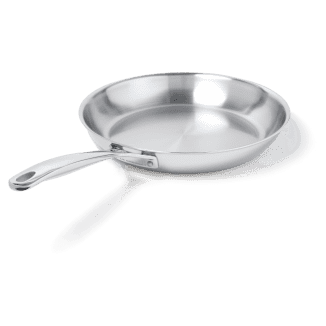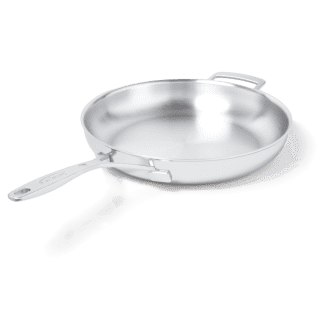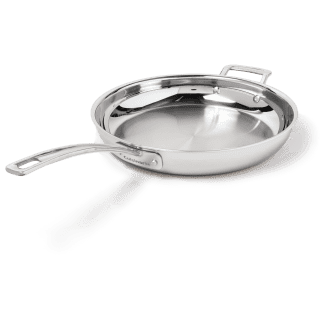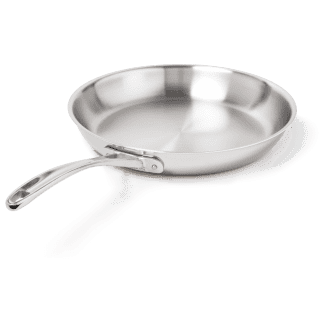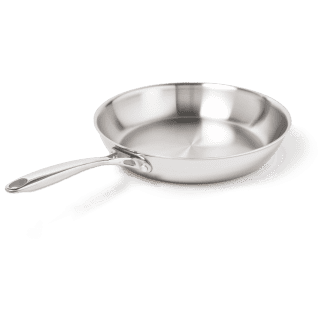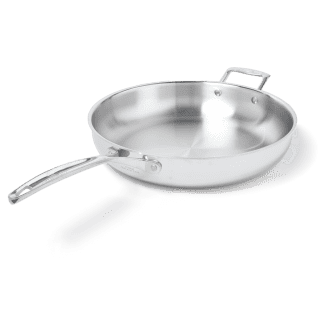





Our longtime favorite stainless-steel skillet is the All-Clad D3 Stainless 12” Fry Pan with Lid. The fully-clad construction helps it heat responsively and brown evenly. Its broad cooking surface provides ample room for searing and sautéing, and gently flaring sides allow for easy access. The straight, grooved handle offers an especially secure grip. Our Upgrade Pick is the Hestan ProBond Luxe 12.5-inch Open Skillet Stainless Steel. It shares the same excellent cooking capabilities of our winner, with a few differences. It’s a bit heavier, with gently cupped sides that encourage food back into the skillet. The subtly offset handle was more ergonomic for our wrists and a rounded groove running down it helped the pan stay locked in our hands without digging in uncomfortably. The rivets securing the handle in place are flush with the interior of the skillet for easier cleaning, and the top edge of the pan is sealed, so it can go in the dishwasher without delaminating.
If you’d like a smaller version of our favorite, we also recommend All-Clad’s 10-inch and 8-inch models.

We love stainless-steel skillets. We appreciate these all-metal pans for their ability to go from the stovetop to the oven, where we finish cooking thicker cuts of meat and fish, bake skillet pies, and skillet-roast whole chickens. And they’re our top choice for achieving golden, uniform browning and developing fond. Unlike carbon steel or cast iron, stainless steel doesn’t react to acidic foods, so you can cook without fear of metallic flavors. Plus, stainless doesn’t wear out like nonstick will. If you want perfect searing; deeply flavorful sauces; and cook-anything, stove-to-oven versatility for a lifetime, you need a stainless-steel skillet.

What Size Skillet Should You Get?
A 12-inch skillet provides plenty of room to cook for as many as six people; you can fit four burgers or two big steaks. Slightly smaller 10-inch skillets are great if you regularly cook for two to four people. Eight-inch skillets are useful for small tasks, such as frying an egg, toasting nuts, or browning butter.
Are Expensive Skillets Worth the Money?
Yes, up to a point. Over the decades, we’ve tested dozens of stainless-steel skillets at a wide range of prices. We’ve found that less expensive skillets—usually those costing less than $100—are often problematic for one reason or another. They’re generally less well-made and less durable, warping or denting more easily or having handles that loosen over time. They can be too heavy, making them difficult to lift and maneuver, or too lightweight, making them prone to warping. And they have other design flaws that make them perform less well. Our preferred models cost more but are worth the investment. They perform better, are easy to handle, and are much more durable—a good one will last a lifetime if you treat it right, saving you money in the long run.
That said, there’s a limit to what money gets you. You don’t need to spend more than $150 to get a good stainless-steel skillet. In fact, our favorite performs just as well as skillets that cost three times as much and is lighter and easier to use than more expensive pans too. For more details, see the FAQ “Do I Need a Five-Ply Skillet?” below.

What to Look for
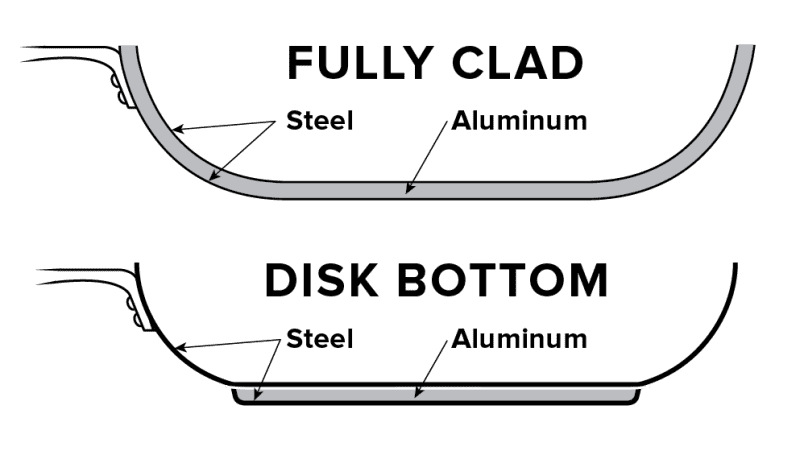
- Fully Clad Construction: We prefer skillets that are “fully clad,” meaning that they are built entirely from layers of different metals that are bonded together. By sandwiching aluminum between two layers of stainless steel, you get the best characteristics of each metal. Aluminum conducts heat quickly, making the pan responsive to temperature changes; steel conducts slowly and retains heat, so the pan cooks remarkably evenly across its surface. Aluminum reacts to acidic foods, but stainless steel doesn’t, so you can cook anything without fear of flavor transfer and damage to the pan. Aluminum is softer and more easily dented; stainless steel is harder, giving the pan better durability. In addition, while aluminum is not induction compatible, stainless steel can be, making a fully clad skillet a good option for different types of stoves. (Note that not all stainless steel is induction compatible; we’ve indicated those that are in the chart below.) Of the fully clad pans, there are 3- and 5-layer options. During testing, pans with five layers cooked about the same as those with three. The overall thickness of the base was more important than the number of layers; too thick and the pan felt sluggish during cooking. Around 3 mm thick was best.

- Moderately Thick, Even Cladding: All cladding is not created equal, though. Depending on the thickness of the layers, which add up to the overall thickness of the pan, pans will perform differently. We preferred skillets that had a moderate thickness of about 3 millimeters. In our tests, skillets that were thinner were less durable, denting or warping more easily when we heated the skillets and plunged them into ice water. Warping can be a pain because if your pan doesn’t sit perfectly flat on the burner, oil can pool and the pan can feel unsteady. This is slightly less of a problem if you cook with gas, but with induction or glass-top electric stoves, a warped pan’s lack of full contact can translate into uneven cooking. Thicker pans also tend to cook better than thinner ones, giving you better heat retention and distribution—up to a point. As we found during testing, some pans can be overly thick, including those that have five layers. As a result, they’re heavy and are sluggish to heat and to respond to temperature changes.


Executive Editor Lisa McManus performs a thermal shock test on a 12-inch stainless-steel skillet to evaluate its resistance to warping.
- Moderate, Balanced Weight: While we liked skillets that were thick and heavy enough to resist warping, we wanted models that were not so heavy that they became difficult to lift once laden with a roast chicken. Pans over 4 pounds empty were prohibitively heavy. Most of our recommended models weigh around 3 pounds. We also considered how well that weight was distributed; the best models felt well-balanced and were easy to maneuver as a result.
- Broad Cooking Surfaces: Technically, the size of a skillet is determined by the distance from rim to rim—a 12-inch skillet thus generally measures between 12 and 12.75 inches across. But after you factor in the angle of the pan walls, the usable cooking surface is usually somewhat smaller. We preferred 12-inch skillets that had broad cooking surfaces of about 9.25 to 10.5 inches across. Whether we were cooking four strip steaks, 2 pounds of asparagus, or eight pieces of chicken, food fit well in these pans without crowding, so it browned more evenly and deeply.
- Low, Flaring Sides: These encourage evaporation for better browning, and make it easier to pour sauces, get under foods with a spatula, or tip foods like asparagus out of the pan.
- Handles That Are Easy to Grip and Stay Cool: The best handles had angled shapes of moderate breadth that let us lock in a secure grip. Our favorites also stay cooler on the stove, letting us skip pot holders.

- Great Durability: Our favorite skillets not only resisted warping and denting but had handles that remained tightly affixed even after we banged them against a concrete block three times.
Nice to Have
- A Lid: You don’t need a lid for your skillet, but we find it to be a handy accessory that increases the skillet’s versatility, allowing you to steam and braise in it.
What to Avoid
- Disk-Bottom or Fully Encapsulated Construction: With this type of stainless-steel skillet, metal layers are found only in a disk attached to the bottom of the pan, which is otherwise constructed of a single layer of stainless steel. In our previous tests, disk-bottom pans heated erratically, and food scorched around the thinner pan sides.
- Thin, Uneven Cladding: Thinner pans are prone to warping and denting and cook less well. As Michael J. Tarkanian, senior lecturer and metallurgy expert in the Materials Science and Engineering department at Massachusetts Institute of Technology, explained, “A thinner pan would have less heat retention because there’s less thermal mass, and it would probably run a little hotter and have worse heat distribution.” When we measured pans that warped, we found that at 2.4 to 2.8 millimeters thick (plus one outlier at 3.2 millimeters that suffered from other design woes), these pans had less armor against damage.

- Small Cooking Surfaces: Smaller cooking surfaces limit the volume of food you can cook at a time. If you try to cook four steaks in a 12-inch skillet that has a cooking surface diameter of 8 inches, for example, the pan will struggle to recover its heat, so one side of the steaks will come out gray and steamed with sparse fond that will make paler, weaker pan sauce. The best skillets had ample room for those steaks, searing both sides beautifully.
- Tall, Straight Sides: These trapped condensation, steaming food instead of allowing it to lose moisture and encouraging browning. Tall sides are great for sauté pans, which we prefer for braises and other liquid-heavy dishes, but they’re not helpful here.
- Heavy Weight: A pan that’s nearly 4 pounds when empty is a bear to remove from a hot oven with a sizzling whole chicken inside.
- Uncomfortable Handles: Handles that were too narrow or thick strained our hands, and those that at first seemed pleasantly smooth and round often slipped and rotated in our grip when they were splattered with grease and the pans were full. Some pans had Y-shaped handles meant to disperse heat, but most of these handles still got hot right where we wanted to grab them.
- Helper Handles: Some skillets had a “helper handle,” a loop set opposite the main handle and intended to mitigate the weight, but that was a misnomer. These handles added weight that threw the pans off-balance, and they were useless when we needed to hold a pan with one hand while scooping out food with the other. They also heated up over adjacent burners and trapped grime.
- Poor Durability: In addition to warping and denting, the worst skillets were poorly made, with handles that loosened after we hit the pans against a concrete block three times.
The Tests
- Make Pan-Seared Steaks and Mustard Cream Pan Sauce
- Prepare Pan-Roasted Chicken with Shallot and Vermouth Sauce in each pan
- Pan-roast 2 pounds asparagus
- Wash by hand after each test
- Wash once in dishwasher using normal cycle and heated dry
- Abuse test: Heat pans to 500 degrees on stovetop, then plunge into ice water
- Abuse test: Whack 3 times on concrete ledge
How We Rated
- Performance: We evaluated the food we prepared in each pan, noting how well foods browned and how evenly things cooked.
- Ease of Use: We assessed the design of the pans and whether they were easy to cook with, maneuver into and out of the oven, and hold aloft to empty onto a serving plate.
- Cleanup/Durability: We considered how easy the pans were to clean and took note of any warping, denting, or signs of damage.